
What your boiler pressure should be in Nevada
What should my boiler pressure be?
Your boiler has a pressure gauge for a reason, and most people never look at it until something seems off. If you're checking it tonight because the heat isn't coming on right, or you just want to know what's normal before winter settles in, the number on that dial tells you a lot. Here's what it should read and why.
Between 1 and 1.5 bar when the system is cold
Check the gauge when the boiler is cold, before it has run that day. A reading between 1 and 1.5 bar means the system has enough water to circulate properly once it heats up. Once the boiler fires and the water warms, the needle will climb, often to around 2 bar, and that is normal. It drops back down as the system cools. If the gauge sits below 1 bar cold, the system has lost water somewhere, and it will struggle to push heat through the radiators. If it sits above 2 bar cold, there is too much water in the system, and that puts strain on the seals. Either way, the fix is usually quick, but it is worth having someone local look at it before winter rather than after the heat stops working.
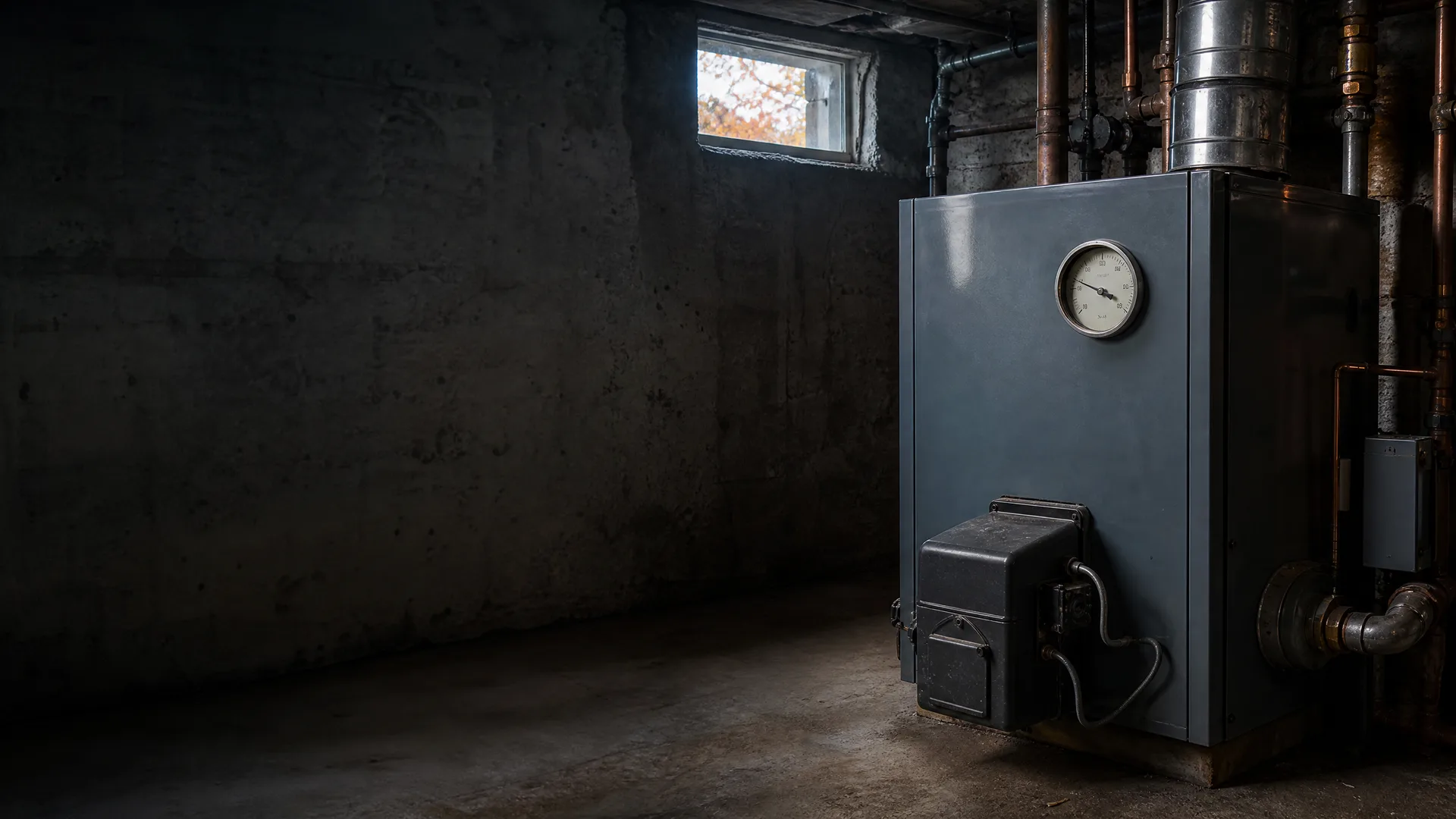
You go down to the basement on a cool October evening because the radiators upstairs aren't warming up the way they should. The gauge on the boiler sits right at the bottom of its range, needle barely off the peg. The pilot light or igniter is working fine, you can hear the burner trying, but the water pressure just isn't there. Outside, the desert air has finally turned, first real cold snap of the season, and this is exactly the night you need the system to work without you thinking about it. You crouch down, look closer at the glass, and realize this is the first time you've looked at this gauge since last winter.
Boiler Pressure: Too Low or Too High
Pressure too low
- Water drains out slowly through a small leak at a valve or fitting, and the gauge creeps down over weeks without anyone noticing.
- Radiators upstairs stay cold at the top even when the boiler is firing, because there isn't enough water in the system to push through them.
- The boiler may lock out and refuse to fire at all once pressure drops below the minimum its controls allow.
- Refilling through the loop valve brings pressure back up, but if it drops again within a few days there's a leak somewhere that needs finding.
- Cast iron radiators and long runs of pipe both need water in them to carry heat, so low pressure shows up as uneven heat room to room.
Pressure too high
- Overfilling the system after a refill is the most common way pressure ends up too high, especially if the loop valve gets left open too long.
- The pressure relief valve can start weeping water onto the floor once the gauge pushes past the top of its range.
- A faulty expansion tank that's lost its air charge will let system pressure climb as the water heats up and expands.
- High pressure stresses seals and joints throughout the system, and a joint that's been fine for years can start to seep once it's under more strain.
- Letting a little water out through the drain valve brings it back down, but pressure that keeps climbing on its own points to the expansion tank or fill valve.
Why pressure drops over time
A boiler loses a little water pressure over months without any single leak causing it. Air works its way out through the vent valve, a joint loosens slightly as the system heats and cools, and the gauge reads a bit lower each time you check. None of that means something broke. It means the system needs water added back and the air bled off, which is routine on any boiler after enough heating cycles.
What the needle is measuring
The gauge shows the pressure of the water filling the pipes and radiators, not the temperature and not how hard the boiler is working. A full, sealed system holds that water at a set pressure so it reaches every radiator in the house, including ones upstairs or at the far end of a run. When the number drops, water isn't short on heat, it's short on the push needed to get there.

What the pressure relief valve has to do with it
Every boiler has a pressure relief valve, usually set to open at 30 psi, and its only job is to let water out before the system is stressed past what the boiler can take. If your gauge ever climbs toward that number, the valve doing its job isn't the problem. The problem is whatever pushed the pressure up that high in the first place, which is almost always the expansion tank. That tank holds a cushion of air so the water has somewhere to go as it heats and expands. If the tank's bladder has failed or the air charge has leaked out, the water has nowhere to expand into, and the gauge climbs fast once the burner kicks on.
Checking the tank yourself means shutting the system down, finding the air valve on the tank, and reading a charge against a spec most homeowners have never seen. A local contractor who services boilers all season already knows which tank models in your area tend to fail first and what the right charge should read, so the visit is a check and a fix instead of a diagnosis you're running for the first time on a system you don't normally touch.

Statewide, winter nights average 33°F, according to NOAA climate data, and that's the number that matters for your boiler more than any daytime high. A boiler sized for Nevada's mild winters still has to bring a cold system up to pressure on those chilly nights, and a system that's already low on water struggles more in that stretch between 10 p.m. and sunrise than it does at noon. If your gauge is sitting under 12 psi and the nights are in the low 30s, that's usually when you'll notice the radiators lagging first. Instead of spending an evening searching around, calling a few places, and explaining the same gauge reading over and over, you can get matched with one licensed Nevada contractor who services boilers in weather like this all winter and knows what a low reading at 33°F usually means.
NOAA nClimDiv 1991-2020 county normals weighted by homes
Skip the search

A licensed local pro takes the request for your boiler tune-up.
Sending the form costs nothing.
How the fill valve and expansion tank work together
- The fill valve, sometimes called the feed valve, is what lets you add water back into the system by hand or automatically.
- Bleeding a radiator releases trapped air but also drops system pressure, so check the gauge again right after.
- A properly working expansion tank absorbs the pressure rise as water heats, so pressure climbing only a few psi when the boiler fires is normal.
- If the expansion tank's bladder fails, pressure swings much higher with every heating cycle instead of settling back down.
- Most boilers have a separate gauge for pressure and temperature, or one combination gauge showing both on the same dial.
- Repressurizing the system usually means closing the boiler valves first, then slowly opening the fill valve until the needle reaches the right spot.
Two parts do most of the work in keeping your boiler at the right pressure, and knowing what each one does makes the gauge easier to read. The fill valve, sometimes marked as the feed valve, is the one you'd turn by hand if the system needed more water, though plenty of boilers fill automatically and only need a manual turn if that fails. The expansion tank sits on the other side of the job. Water expands as the boiler heats it, and the tank gives that extra volume somewhere to go so the pressure doesn't just keep climbing. A rise of a few psi while the boiler is firing is the tank doing its job. If you see the needle jump much higher than that, or swing wildly from one heating cycle to the next, the tank's internal bladder has likely failed and stopped absorbing the expansion the way it should.
Bleeding a radiator touches both of these systems at once. Letting the trapped air out is necessary, radiators with air pockets don't heat evenly, but the water that comes out with the air takes pressure with it. Check the gauge again once you've finished bleeding, because a system that read normal before might need water added after.
If you do need to repressurize, the order matters. Close off the boiler valves first, then open the fill valve slowly and watch the gauge rather than guessing at how long to leave it open.




You can top off the pressure yourself with the fill valve, and plenty of people do it for years without trouble. It's a fair way to handle the odd drop as long as you know what you're looking at on the gauge.
A boiler tech who works on these systems every week can tell you whether that drop is normal wear or a leak starting somewhere in the pipes. A local contractor can take a look without a parade of companies calling you about one gauge reading.


Checking it yourself tonight
You can check your boiler's pressure in a couple of minutes without any tools. Look at the gauge, note where the needle sits, and compare it to the range marked on the dial, usually shown in a different color. If it's low, the fill valve lets you bring it back up yourself. If it's high, bleeding a radiator or two will often bring it down. Either way, you've got your answer tonight, and you can decide from there whether it's a one-time top-off or something that keeps happening. Plenty of Nevada homeowners handle this part on their own, especially once they've done it a time or two and know what their system looks like when it's running right.
When it's worth a second opinion
If the pressure keeps dropping every few weeks, or it climbs back up near the relief valve no matter what you do, that's not something to keep patching yourself. Finding someone for this usually means searching around, calling a few places, explaining the same gauge reading over and over, then sitting with quotes trying to guess who actually knows boilers versus who just does furnace work on the side. This page gets you to one licensed contractor near you in Nevada, someone who works on these systems through the fall and winter and has seen what usually causes a steady leak or a pressure that won't hold. One call, one answer, instead of sorting through several.
Winter nights average 33°F statewide
A night in the low 30s means your boiler is starting cold most mornings all winter, not just on the odd cold snap. Every one of those startups pulls pressure down a little as the system heats up from scratch. Checking the gauge once a week matters more here than in a place with milder nights.
NOAA nClimDiv 1991-2020 county normals weighted by homes
A cold-fill boiler should sit between 12 and 15 psi, and once it's heating, that needle should climb into the 20s without ever touching the red. That's the whole answer. If yours sits outside that range tonight, it's telling you something, whether that's a slow leak at a fitting or a fill valve that needs a turn. You don't have to work out which on your own. A boiler tech who services these systems through every Nevada winter has likely already seen whatever yours is doing, because the same handful of things cause most of the trouble: a worn valve, a bit of trapped air, a gauge that's finally given out. Request help through this page and it goes to one licensed local contractor, not a handful of companies competing for your callback. No sorting through quotes, no explaining the gauge reading more than once. Just someone who knows these boilers taking a look at yours.





Explain it one time
Only one pro gets your request, so you hear from one company.
You're not committing to anything by asking.